May 13, 2026 | Portfolio
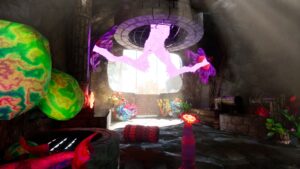
“Liquidus” is a first-person, narrative-driven, puzzle game set on an aqueous planet. The planet is in peril because the Solidus have destroyed the water geodes and left the inhabitants to dry up. As a last resort, the Liquidus aliens have abducted the “Plumber of the Universe”. As the plumber you must solve puzzles, repair pipes and traverse a rich alien landscape using ancient mechanical mechanisms left by the planet’s elders. Your goal is to restart the geode and ward off the Solidus, returning the planet back to peaceful harmony.
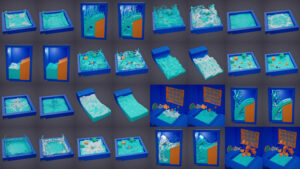
The player will navigate the complex cave geode under the watchful eye of the Liquidus aliens. To restart the geode, the player must redirect liquid to power water wheels, mechanical devices and push objects. The puzzles are accompanied by detailed fluid simulations. The fluid is implemented into engine using my own custom system which reduces the footprint of the simulations by up to 90%. This allows the fluid simulations to run efficiently on a range of hardware with little performance impact.
I created this work as part of my third year at university in response to an open-ended brief. I was tasked to create a playable game demo with custom mechanics and assets. Additionally, I have incorporated my dissertation into the project by testing the feasibility of the custom fluid storage system within a game environment. From a young age, I have loved fluid simulations and wanted to integrate them into a game; this project has allowed me to achieve this ambition.
This project has been a step up in the quality of my production capabilities. I have used my skills to create a realistic, large scale game environment where all aspects are created in house. This includes music, sound effects, models, textures and code.
Apr 20, 2026 | Portfolio
VGC is an abbreviation for Video Geometry Cache. VGC is a new, in-house alternative to Alembic Geometry Caches designed for exporting, storing and playing back pre-calculated fluid simulations.
I need your help to test the quality of Alembic vs VGC. If you are interested and have a spare five minutes, please come and take a look.
Feb 1, 2026 | Game Jam, Portfolio
I have had a fantastic weekend taking part in The Global Game Jam 2026, working to produce a game centred around this year’s theme of “mask”
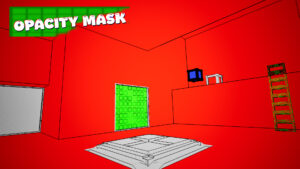
Creating an idea that met the theme while being outside the box was a thought-provoking task. I pitched a mechanic for drawing opacity masks onto meshes to solve puzzles.
It was a privilege to work with Ryan who created the 3D assets, 2D signage and created most of the puzzle levels.
I am incredibly pleased with the project outcome and impressed by the mask collision system which uses voxels to approximate a collision mesh in the shape of the masked material.
See the Global Game Jam page here: https://globalgamejam.org/games/2026/opacity-mask-9
Jun 4, 2025 | Award-Winning, Portfolio
Stories from the Event Horizon is a winning entry in the Young Creative Awards Nottingham 2025 Animation & Digital Media 19-24 category!
“Stories from the Event Horizon” is a groundhog, time loop game with an emphasis on an intractable narrative. The game takes place on a spaceship designed to unlock the mysteries of black holes. A catastrophic failure occurred, causing the ship to be consumed, lost beyond the black hole’s event horizon. All hope was lost, until a tech support representative received a call from a member of the crew. You are part of a story being recounted in an inquiry by the tech support representative. Your goal is to explore a plethora of different and sometimes comical endings by following orders from the tech support representative to escape the doomed ship and time loop. I have created custom shaders and utilized clever level design tricks to create a non-Euclidean spaceship layout. My favourite part of the project was seeing the final blackhole physics simulation in engine for the first time.
This project has seen a step up in my production capabilities. I have created all aspects of this project including the music, sound effects, models, textures, and code, all to a realistic standard, in house. I have not had to source any resources from online.
Apr 30, 2025 | Portfolio
Find it for Real is a digital recreation of Confetti Institute of Creative Technologies DMH building in Nottingham. The project aims to make it easier for new students to find their way around the building by gamifying the search for rooms.
In the arcade game mode, players must find as many randomly selected rooms as possible before their time runs out. To get into the rooms, the player must find the right colour coded keycards and use the x-ray, guide and time slow power ups. The x-ray power up allows the player to see the locations of keycards through walls, the guide powerup shows the quickest route to the required room and the slow time power up slows the countdown timer. Some rooms can be hacked open by matching lessons on a timetable. Random events such as flipped worlds, power cuts and slippy floors can hinder the players progress by taking up valuable time.
The course finder game mode is a race to find a specific room chosen by the player, the mode features the same power ups and random events as the main arcade mode.
Finally, free roam game mode lets players freely roam and explore the building with all doors unlocked.
This project was created over the course of several months as part of an amazing team with Qasim Hussain and Ethan Taylor. Qasim and Ethan created all the assets and assembled the rooms while I created custom tools and pipelines to convert NTU MazeMap data into a to scale model of the buildings interior walls. The data was backed up by hundreds of measurements and reference images.
May 20, 2024 | Award-Winning, Portfolio
TIC is Alive is a winning entry in the Young Creative Awards Nottingham 2024 Animation & Digital Media 19-24 category!
“TIC is Alive” is a 3D, puzzle platformer with a heavy narrative focus, centred around the TIC system which replaces traditional computer architectures. In the game you play as TIC, a Transfer Instruction Commander, with the goal of delivering data packets. The path is not straightforward; you must solve logic puzzles using your electron gun. Electrons power puzzle elements when they are fired into receptacles, these pair with the games interactive logic system which has logic gates forcing the player to think logically about the puzzle. To make level design easier, I have programmed a logic system which allows actors to easily communicate with each other. This has resulted in huge time savings when creating the levels for TIC is Alive.